Showing posts with label on-line chess. Show all posts

Monday, November 5, 2012

On-line Chess - Part 1.18 - Play for free

The most famous chess web sites hardly allow a player to play for free (unless you are a very famous chess player, in that case you are very welcome to join). Important chess servers’ access is not free but you can try for free for one week only. Others require a free registration with limited features and a premium registration with prices per month, 3 months, 6 months and per year. Premium memberships are full options in this case but there is a saving for long term registration.


Figure 14 – http://www.chesscube.com premium membership fees


Another policy is to have different premium memberships from the lowest level one with some features only to the highest level with full features.


Figure 15 – http://www.gameknot.com premium membership fees


Usually free registration limitations are on

  • the number of games playable at the same time or in a day, 
  • the possibility to access tournaments, 
  • the number of game archived is limited, 
  • computer analysis is not allowed, 
  • play in teams is not allowed, 
  • very basic statistics, colors and pieces customization are not allowed, just to mention a few.

Other providers who ask money as well to all the members offer an “exploration” mode in which the user can play for free for a limited amount of time or games. Expired this period they are invited to pay the fee for the next games.
Talking about money, some web sites allow playing with money (both symbolic and real). I understand that could be attractive for someone but I believe playing a game gives other immaterial earnings.


Saturday, November 3, 2012

On-line Chess - Part 1.17 - Other stuff

Playing chess on-line attracts several people, from the field and not. So it is not surprising that a web site providing the possibility to play has a store of chess material (boards, chess pieces, chess clocks, magazines, books, training material like videos, collection of games and so on). Another interesting feature to attract people mad of chess is chess puzzles. You are asked to solve the problem of the day typically. Sometimes the web site holds news from the chess world, tournaments, top players events, chess social events or international events with video, photos and articles. What about people who are not close to chess world? They want to find only an opponent to defeat or to chat with, the rest is useless…but is nice to have for the chess community.

On-line Chess - Part 1.16 - Population

It is very annoying to log-in, create a game and wait plenty of time because no one else in connected. Some popular web sites are full of people ready to play so that you don’t have to wait more that few second to find an opponent. Some other is completely unknown or less popular and the risk is to waste your time. There are some interesting web sites still unknown that are worth playing at, so I don’t want to give the advice to leave them empty. On the contrary I want to foster visiting those web sites, try and let them take off, especially if they are free!

Thursday, November 1, 2012

On-line Chess - Part 1.15 - Graphics

Beauty is a subjective parameter during the evaluation of a web site. What does it mean? When you play chess at home or in a chess club it doesn’t matter if the board is made of cardboard and the pieces are made of plastic. What’s really matter is the game, the battle and who will win. Is it really true? If you have the chance to chose between a cardboard chess board and a wooden board with sheesham chessmen, which one will you chose? Now, back to the on-line chess. There are a lot of chess pieces pictures on the web and the game providers let their user to choose between different styles, colors and dimension of both sets and board squares. Sometimes the number of possibilities is limited if the subscription is free while if you pay for a premium subscription the choice is greater.


Figure 13 - Graphic interface Come2Play from www.come2play.com

Chessboard and sets are not the only graphic parameter to judge. Font is another parameter. Sometimes the font is too small or the text components in the web page are too close, or on the page there are fonts of different kind. If the web page contains too much information with small font together with bigger and different font, it could be difficult to find the information you need.

Anyway the beauty is subjective. Someone prefers simplicity: few things but very good.

Wednesday, October 31, 2012

On-line Chess - Part 1.14 - Play everywher

Nowadays computers are not the only mean to reach internet. Cell phones, smart phones, iPhone, iPod, Wii and so on have access to internet. Big online chess providers know about this revolution and adapted their web sites to be reached from those devices. The cost is high for the provider and so it is difficult to find this feature for free. Typically there is an application to download on your portable device which is the client program. Even if the download is free, if you want to play often or affect your rating you should pay a fee.


Figure 12 – iPhone application provided by http://www.chess.com

Furthermore social networks counts thousands of people and give the possibility for developers to public their software to be used by social networks’ users. So if you want to play chess online you surely will find a way!

Tuesday, October 30, 2012

On-line Chess - Part 1.13 - Security

On a real chess game it is not possible to cheat. Online chess games instead can be cheated in several ways depending of the security model implemented. Yah, the server receives the information about the move and the timestamp from the clients. Nobody is able to see what the user is doing sitting in front of his/her PC. Let’s start from the most common cheating type: the computer aid. Instead of using their own brain, cheaters open a window on their PC where their favorite chess program is running. The position of the game in progress is replicated in the chess program and analyzed by the CPU (which will do the dirty job), the program hints the best move for every position and unlucky opponents can be defeated soon if not stronger than the machine. The consequence is that cheaters gain points rapidly and they will be at the top of the ladder even if not deserved. Is there a remedy for that? Some online game providers claim they have one. The principle is that suspicious games are analyzed with a computer engine and if there is a match that is the footprint of a cheat. Can anyone be sure 100% that it is a cheat? Difficult to say. Anyway other techniques can be added and the following three are just examples:
  • The rating evolution is monitored because a quick rising of the rating is a symptom of good game but also of cheating. 
  • The suspect cheater is notified by a message encouraging him/her to stop cheating or simply informing that from now on a strict monitoring will be performed on his/her games. 
  • The suspect cheater is marked so that every user knows what could happen if they accept a challenge from a suspect cheater. 
  • The number of times the game is suspended is monitored. It could be an indication that the player is using the time to query a chess program.
When the cheater is confirmed he/she is banned from using the chess service.
Another popular way to gain points is to play against yourself. Cheaters create two accounts and winning against themselves let them improve their rating. Some game providers overcome this techniques by force the users at registration time to accept to not create more than one account otherwise they will be banned. Some other game providers instead have tools to detect if the players of a game come from the same IP address. What if the cheater uses two different PC?
  Another historical way to cheat an opponent is to interrupt the game when thing is going bad on the board. Let’s think the case there is a temporary connection failure of a client. Some game providers simply null the game because they think it is unfair to assign a result in this case. But cheaters could turn off their computer in order to simulate an internet connection failure. Usually providers face this problem in two ways:
  • adjourning the game when accidental disconnection has happened and give the chance to reconnect in order to complete the game 
  • declaring the victory for the player remained online
Other providers claim they have an intelligent system able to recognize abusive game interruptions, which is the best solution to the problem.
Now let’s have a look at complex cheating techniques. As we already said, the client program sends a time stamp together with the move up to the server. Time stamp could be modified to get more time. Usually the connection between the client and the server is encrypted but even the most famous chess server (ICC) has not a strong protection against hackers that could decrypt the message and change the time stamp.

Monday, October 29, 2012

On-line Chess - Part 1.12 - Customizations

As a user of the game service you have the chance to customize the interface you use to play. Type of chess pieces and colors of white and dark squares of the board are examples of personal settings.
 Figure 11www.chess.com board settings

Another common one is the automatic pawn promotion to queen. Even if sometimes there are not so many choices this features in nice to have. The move highlight is useful when you want to see quickly what the opponent move is when you come back to your monitor. Other minor settings are the movement of the piece when you move or the alert sounds.

Sunday, October 28, 2012

On-line Chess - Part 1.11 - Analysis

Your games are stored in a database so they are available to all people to inspect and comment. Analyzing games is useful for improvements and on-line gaming providers allow their users to have this feature. How? In several ways. First of all the user can post the game to a forum and wait for someone to review and comment. Simple and effective, because when a lot of people could analyze your game and so the amount of data produced could be very interesting, with no cost for the provider. The drawback is that it could happen no one wants to review your game or the reviewers are not good enough. Sometimes there is a committee entitled for reviewing the games when required. In this case the guys in the committee should be prepared enough for producing good quality comments. Another scenario is the help of a computer program. Your game is put in queue and it will wait to be processed by a chess engine. This solution has a cost in terms of hardware resources to guarantee the service to every user, while the chess engine could be open Source. Other commercial chess engines, like Fritz for instance, perform better analysis so someone prefers to download the PGN format of the game and run his/her favorite chess engine for a deep analysis.

Analysis is good for training but is lesser amusing than reviewing the game with your opponent at the end of a match, still in front of the chessboard with the clock still warm. Ok, the quality of the analysis is poor but you still have your variants in your mind and would like to see the reaction of the opponent.

Saturday, October 27, 2012

On-line Chess - Part 1.10 - Game archive and statistics

A good player takes note of the move list of his/her games in order to analyze later and improve from mistakes. No piece of paper is required when you play on-line chess because the system takes note of the game moves and save the game in the Portable Game Notation format in a database. That’s really useful. Database access makes it easy to query for a match against an opponent or for a game played years ago. You can then review the game using your client program or download the PGN file and open it using your favorite computer chess program in order to let it analyze deeply the game and find the mistakes and good moves. Game archive has a cost for providers of the gaming service (disk space is not for free), for this reason usually if you want to store all your games you have to pay while free subscription have limited storage size.
Figure 10 – www.geekswithchess.com game archive

Another possibility is to upload games in PGN format on the database. Even if they are not played using the provider service, this is a way to collect the games you want on the net so they become available everywhere an internet connection is available.
Statistics are another interesting feature. In the basic form statistics report the number of games played, won, drawn and lost. Advanced forms could report your rating evolution over time or the statistics on openings used in your games and several ways to present the data graphically. Any means to show you how strong you are is appreciated.

On-line Chess - Part 1.9 - Games watching

If you ever entered a chess club, for sure you have stop by a table watching a game in progress. Observing a game in progress just like a real spectator is possible also on-line. Typically there is a list of ongoing games and you can join to watch one of them. Some time you are allowed to write down messages into the local chat.
Figure 9www.chess.com game view panel

Sunday, September 30, 2012

On-line Chess - Part 1.8 - Other play possibilities

Usually you are not allowed to play more than one game at a time mainly for security as we will see later. That’s not true for all the gaming sites.
But let’s go back to the rating concept. You can play against anyone and increase your rating, very easy. Too easy maybe: in the real world to increase your rating you should participate to official tournaments. For this reason it is very common to find tournaments on-line. Tournaments start when a certain number of people join the tournament which is scheduled at a fixed time and publicized on the site.
Tournaments could be of various types:
  • In round-robin tournaments each player plays against every other player in two games (once as white, once as black). The winner is determined by the score but when two players have the same score a tie-break method can be used. The tie-break method widely used for this kind of tournament is the Neustadtl score. A player's Neustadtl score is calculated by adding the sum of the conventional scores of the players they have defeated to half the sum of the conventional scores of those they have drawn against. Round-robin tournaments are simple but they are effective only when the number of players is limited to few users.
  • Knock-out tournaments are used when there are a lot of players in order to reduce the time taken by the competition. Players are put into smaller groups and then the winner(s) of that group are combined with winners of other groups to form a new group. The winner(s) of the final group are the winner(s) of the entire tournament. One or more players could advance from each group. If one only has to advance, a tie-break method is used.
  • A Swiss tournament goes for a predetermined number of rounds, with all of the players taking part in each round. In each round two players compete head-to-head. All players participate in the entire tournament – none are eliminated. The winner (and top places) of the tournament is based on the final scores of the players. The final score is based on the number of points they accumulated for each round. The tournament lasts for a number of rounds announced before the tournament. After the last round, players are ranked by their score. If this is tied then a tie break score, such as the sum of all their opponents' scores (Buchholz chess rating), can be used. The Buchholz System is in fact the sum of the score of each of the opponents of a player. 
 
When the users of a web site are quite a number, it is common to find teams of players playing against. Not a one-to-one challenge but a many-to-many challenge. The team wins if the score of its members is higher than other teams after the fight. Team members become friends, they exchange information trough dedicated chat.
Also teams can compete in tournaments. In this case the rating is different.
Some game providers allow users to play different chess variants and gain rating also for those games. The most popular chess variants you can find are
  • Chess 960
  • Reverse (suicide chess)
  • Checkers
  • Bughouse

Friday, February 25, 2011

On-line Chess - Part 1.7 - Challenges


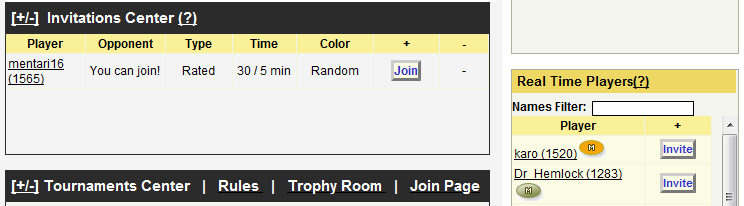
Ok, you logged in to a chess on-line web site and you are ready to start a game but how could you find an opponent? There are several ways to. The most common is the direct challenge: from the list of on-line users you chose the one you would like to play with. Yes, maybe you know the player by its nickname and would like to play with him/her, or looking at the player rating you can chose to challenge someone a bit stronger than you to increase your own rating. So the choice is yours in this case.


Figure 7http://www.chesshere.com allows the player to invite another player and to show the list of current invitations

There is another possibility: you create the game you want (setting time limits and color for instance) and wait for someone to come to your table. In the other way round, you see a list of created games with their characteristics and you can chose to join the game you want. Nice, but you may ask: “why should I see a list of lots of games I don’t want to play?” In fact, you may be not interested to play against too much stronger people, or too much weaker people. That’s why some good gaming web sites allow their user to set constraints when creating the game. Those constraints limit the possible opponents to players with a rating inside a fixed range or inside a range around the creator rating (300 points below and 300 points above for instance).


Figure 8http://www.chesscube.com game creation with rating range constraint

A similar concept is used by other sites where each player specifies the constraints and the system will find automatically an opponent that fulfills that requirements: the user does not chose to join the game because it is not allowed to see the list of created games.

What happens if there is none who can play with you? Play against a computer seems to be a forced choice but is it what you really wanted? It is better to be clear: “Sorry, no one available. Retry or if you want you can play against the machine”.

Interesting is the feature to invite a friend of yours even if he/she is not a registered user. The invitation needs only the email address and if your friend is checking his/her email in that moment he/she could join the game with you (but if he is not connected…).

I talked about friends. That is a concept widely used in most gaming web sites. You have the chance to maintain a list of other users (your friends) and check if they are connected, if so you can challenge one of them or chat with him/her. The concept behind is simple: a friend is someone you want to be connected with, someone you want to play with often. Some online chess providers have another interesting feature which is the opposite of friends: a list of people you don’t want to play with. In fact when the system finds automatically an opponent for you, you won’t have the chance to reject the match usually (in some case instead that is possible: the game can be null if the player doesn’t move his first move or acknowledges the match). Using the black list (or block list or no-play list) the system will not create a match between you and the undesired user.

Thursday, February 3, 2011

On-line Chess - Part 1.6 - Rating and levels


Why playing a game like chess is addictive? Because it is a beautiful game! Yes, of course. Because you meet people! Yes. Because you like the theory behind! Yah. But unconsciously a better answer is because you want to prove you’re stronger than the opponent. Another variant: because you want to prove you’re stronger than a lot of people. A more modest variant: because you want to prove you’re the strongest player, that’s all!

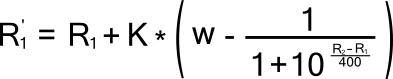
Rating helps to find your strength among other player. ELO rating is the most used. It is a simple formula returning a number: bigger the number, stronger you are.


Figure 6 – Rating computation formula. W=1(won) or 0.5(tied) or 0(lost); R1 is the current rating of the player, R1’ is the new rating, R2 is the rating of the opponent, K is the maximum possible adjustment per game and this constant is set to 32 unless the player has a provisional rating, in that case K depends on the number of games played by the opponent.

Talking about ELO rating is not completely correct. It is more correct to talk about a rating used to have a rank in a top list.

Every provider uses its own formula, especially because ELO rating formula doesn’t work well when the players have played too few games. This is the problem of how to start computing the rating.

In order to start the rating computation you should have an initial rating. There are different ways:
  • get a fixed initial rating (1200, 1400 or 1500 for beginners) from the system; 
  • play a bunch of games without having assigned a rating so that after this period the system can determine the best estimation of your rating. Sometimes the system accept hints about your experience in chess in order to find the most appropriate opponents for you during the estimation; 
  • play with a provisional rating for 20 games and after that your rating is established. In this case the rating is computed using different formulas for established and provisional players. The initial rating is chosen by the player during the registration.
A derived problem is to take into account the fact that a player could have been away from tournaments for years before start playing again. This is a special case of the previous problem in fact in both cases the rating of the player is not sure. For this reason some providers use a different and more complicated formula called Glicko System [1].

Ladder is another possibility. No rating, only a rank in a ladder. People who win will raise the ladder, those who lose does not rise and soon will be taken over by others. The goal is to be at the top of the ladder (rank 1) instead of having the highest rating.

Famous chess programs have the concept of levels: beginner, intermediate, master. Splitting the number of games into rooms is useful to spread the load over more game servers. So why not create rooms based of player levels? Yes it is possible but less attractive than rating, isn’t it?

Ratings, ladders and levels are usually different for different categories of game: correspondence game, classical game, blitz game (3-5min), bullet (less than 3 min) and chess variants have their own rating.

Today I don’t feel concentrated enough but I would like to play a game anyway, just to spend time, but if a play and I lose I will compromise my rating. Some web sites give you the possibility to play a not rated game, so you can still play for training for example without compromise your rank or your rating.
Almost all providers ask you to sign up before starting use the service. It is reasonable because at least your nickname should be visible by your adversary. Someone could think: “why should I give my personal information like e-mail and nationality if I’m just trying to play a single game?” Very few web sites let you play chess as anonymous: no ratings, no registered games, no customizations, just play! In case they like the service they will sign up whenever they want.

[1] The Glicko System, Mark E. Glickman, http://math.bu.edu/people/mg/glicko/glicko.doc/glicko.html

Friday, January 28, 2011

On-line Chess - Part 1.5 - Social meetings


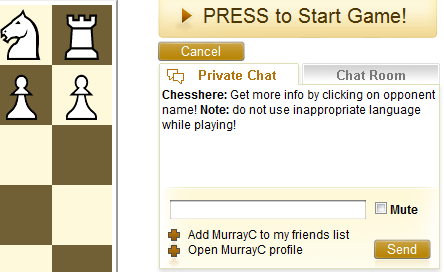
Usually when you play chess you don’t speak with your opponent…or you don’t speak at all. But on-line it is different, people like chatting, like knows something more about the opponent person rather then its name and nationality (and optionally an avatar). A chat feature is always provided by every on-line gaming web site. You can find different kinds of chat:

  • during the game: it is a private chat only between the two players; 
  • public or general chat: every user can post a message and usually is for wave a challenge; 
  • in rooms or thematic chat rooms: nothing to do with playing chess, it is just chatting; 
  • among team members: a team is a group of player that competes against other teams; 
  • in clubs: a club is the place where you can meet new friends, discuss things and play games. It can be found by anybody and club founder and club moderators are responsible for everything that happens in the club.
Chats are usually controlled in order to filter offensive words. The abuse of the chat service is mentioned into the terms and conditions of the service and it is punished by banning the bad user. In some cases the chat is forbidden for users under 13.


Figure 4www.instantchess.com private chat


Figure 5www.chesshere.com private chat and chat room

Almost all web sites allow their users to have a list of their friends in order to connect with them easily by chat or for playing. When you meet a new player in a game and find out he/she is a good player or simply it is nice to chat with, having him/her in your list help you looking for him/her when you connect next time.

So, on-line chess gaming web sites are, as a matter of facts, a sort of social networks and in most case is possible to find connections with popular social networks websites like facebook.

Thursday, January 27, 2011

On-line Chess - Part 1.4 - Live or turn based

What do you think when you say chess? Yes, two people sat down by a chess board from their own side, thinking most of the time, handling their pieces from time to time and struck their clock button. Oh yes, I have seen also two people at the chess board, handling their pieces stressfully without any break, beating on their clock button with violence and thinking only in the spare time. Those scenarios are two typical examples of classic chess games (the second one is the so called blitz game).
Wait a moment. There is another kind of game, historically very important. It is correspondence chess. Two players exchange their moves by mail. There is no time constraint (or they are quite long).
Correspondence chess is easily implemented over internet. Each move is stored in a database and the player simply could be notified by e-mail that the opponent move has been issued. This kind of game is sometime called turn based game or postal game. A game of this kind must have an end, so there are long time limits to finish the game and to make a single move (I’m talking about days). Furthermore, what happens if you have a game in place from days but you have to go far from your (or any) PC for any reason but you don’t want to lose? Providers of such kind of chess game give you the possibility to go on “vacation” for a period: the game is simply suspended and everybody is happy. Vacation time is limited of course and during a game you cannot go on vacation more than a certain number of times.
The equivalent of classic chess is live chess or real time chess. In this case the chess clock plays a crucial role because the time variable can condition the game (and let people to make mistakes but that’s part of the beauty of the game). Often you can chose the time control with an extra time per move rather than the sudden-death approach: you will see two numbers when you chose the time limits, the first is the amount of time a player has in order to finish the game while the second is the bonus in seconds added to your clock every move you make. In the sudden-death time control when the time expires there is no time to play a single move.
Now, think at the following scenario: you are playing a live chess game, make your move and your clock stops while your opponent’s one starts (automatically done by the client program – what a great privation! I loved pushing the button on my classic chess clock.) but your opponent won’t see the move instantly because, due to the connection speed, the move information has to be uploaded to the server and forwarded to the opponent client. This time is called lag. Your opponent will see your chess clock going on for the time of the lag and when the move is received the clock goes back to the real time stamp.
Figure 3 – Lag example: client A sends its move to the server which forwards it to the client B. Client B receives the move and starts counting the time of B (Tb). When B moves it sends to server both the move and the time spent for the move Tb. Due to delay in B connection, the server receives the information after a time called LAG. In the meantime the clock B of the client A was ticking down and when A receives the opponent move and time, the clock B is updated and it appears player B has gained time, but it has not.

Any consequences? The total game time is longer that the one agreed at the beginning of the game. This is not a big issue because the lag time is a dead time for both players. Nasty instead is the situation very closed to the time zero: you make your move at 0:00:03 but your opponent receives it only after 5 sec. In the meantime your opponent sees your clock becoming negative and starts thinking happily about the victory but then receives your move and … checkmate! Gosh!
It is not advised to play rated games when a player has great lag and some web sites does not allow playing blitz games in case of consistent lag, in fact delays of seconds in the connection could make lightening games unfeasible.
Sometimes the players recognize the lag is increasing too much during a game and the provider gives them the possibility to abort the game or to adjourn to another day.

Some chess playing web sites have different approaches to lag phenomenon:
  • simply don’t do anything;
  • lag compensation: clocks are compensated with average lag. The perception of excessive lag effect is reduced and the lag is continuously measured;
  • automatic abort or adjourn of the game
  • not automatic abort or adjourn of the game but players agreed upon that adopt policies in case of lag
Very poor connections are affected by interruptions. Some good web sites takes care of poor internet connection of its users, when the disconnection arises the game is adjourned automatically or the user online gets notified to wait more, giving the time necessary for the disconnected user to reconnect and continue the game. That could lead to cheating problem and needs to be faced with (see security section).

On-line Chess - Part 1.3 - Language support

If you can speak English you could play with a lot of people all around the world because most of chess web sites have English as allowed language. Looking around I found out that language support is not provided by most of the sites. Language support means that an Italian player, for instance, could log-in the web site and find an interface with Italian content (buttons, links, information, alert messages, tutorials and so on). Ok, it is true a chess player has to know at least English language nowadays and if he/she wants to play anyway I’m pretty sure he/she will be able to somehow (chess has its own language!) but why limit people to use the playing service because they have never studied English?


Figure 2www.chessmaniac.com language support is far to be perfect. Italian and English words lives together in the home page
When you have to chat to some other player through the service an interesting but limiting solution has been adopted: a set of prepared phrases are ready to be chosen in the language of one player, the destination player receives that phrases translated in his/her language. Undoubtedly is a plus, but what a wonderful chat when the discussion needs to be complex!

On-line Chess - Part 1.2 - Client program

Every web site allowing users to play chess has a client program. A client program is a piece of software that interfaces the player with the game server. In the past the client program was downloadable but this solution is not considered very attractive because once you install it on a PC you are compelled to use that PC to play on-line. On the contrary, if the interface player-server is usable without downloading and installing any software, the player will be able to play theoretically from any PC or any device with an internet connection (play-everywhere-every-time principle). Anyway there are benefits using downloadable software: - the client is nicer, has better graphic and outstanding effects
- once installed you don’t have to wait for loading from internet any data to start a game

That’s the reason why the most popular chess servers are still accessible by downloadable software. Usually those servers have a standard interface allowing different programs to connect with (Fritz and WinBoard to mention a few).
Moreover downloadable clients are very easy to use for mobile devices because they can be customized for that platform so it is quite common to have a mobile application downloadable for free even if the desktop access is performed by web technologies.

Nowadays fat clients can be implemented with relatively recent technologies (actionscript, java, javascript, Ajax, Silverlight, …) usable by any browser, and faster computers and internet connections make downloadable software less and less attractive. Most of the client programs you can find on the web for chess are written in JavaScript. Java applets are also used but the time to load the program is notoriously greater. With latest version of java (JRE and JDK > 1.6) applets are faster than before so, even if they are not considered the best approach by most of people, maybe java applets deserve more consideration now than before. ActionScript is the language of Adobe flash (or Flex): it is not a free technology like java but it is powerful and allows exploiting the flash library for graphics. It is worth saying that at the moment Apple is attacking Adobe because flash is not performing well on its handset devices; Microsoft and Google are supporting Apple against Adobe so the future could not so brighter for Flash as in the past and other technologies like HTML5 will come soon.

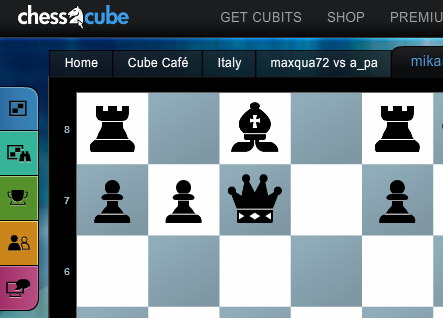
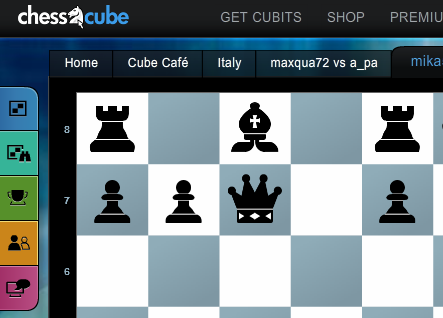
Figure 1www.chesscube.com client interface implemented using flash technology.

Of course, in order to play using a java client, the local PC (or mobile device) must have java correctly installed and enabled in your browser. It is free and maybe you will find it already installed because java is used by many other applications.
Same for actionscript. You should have Flash installed on your PC. It is free and several web sites require flash for other purposes.

Typically the client program allows the user to pick up a piece from the chess board and perform the move. The move is validated and sent to the server (hopefully encrypted) which forwards it to the opponent client program. Client programs could be thin in the sense they could not perform any validity check but just reporting the move to the server which performs checks and holds the status of the game, or they could be fat in the sense they hold the logic to performs all the checks and may or may not hold the status of the game. Some clients have also the responsibility to show the list of connected players but sometimes the program does only the minimum required and other technologies are used to perform database accesses.

On-line Chess - Part 1.1 - Concepts

Playing chess is a passion for a lot of people around the world. When I was young I remember I played chess at school, in clubs and in tournaments. It required me to be updated on chess events and to find chess clubs near home. Internet has been a great revolution for finding an opponent. Although playing in front of a real board with real pieces and real clock and against a real human is an experience you cannot live on-line (the smell of wood, the noise of a piece exchange, the touch on the chess clock not to mention the flag of the opponent which seems to drop in a moment but never falls, …), playing chess over internet is by all means easy, quick and costs zero (unless you want special services).
This article has the goal to lead the reader through the world of chess gaming on-line. In part 1 I will start introducing the main concepts and features of the subject according to what is possible to find over the net, for free or by paying a fee, and I will conclude evaluating a set of existing web sites providing the chess gaming service in part 2.

Outline part 1:
- client program
- language support
- live or turn base
- social meetings
- rating and levels
- challenges
- other play possibilities
- games watching
- game archive and statistics
- analysis
- customizations
- security
- play everywhere
- graphics
- population
- other stuff
- play for free

On-line Chess - Abstract

This series of articles explores the on-line chess world, the concepts behind and the features a player can find when he wants to start playing chess on-line. Moreover, a comparison of the features of the most popular web sites has been enclosed in a table ready to use for everyone who can chose the place where he/she wants to play on for free.