Showing posts with label correspondence chess. Show all posts

Thursday, February 3, 2011

On-line Chess - Part 1.6 - Rating and levels


Why playing a game like chess is addictive? Because it is a beautiful game! Yes, of course. Because you meet people! Yes. Because you like the theory behind! Yah. But unconsciously a better answer is because you want to prove you’re stronger than the opponent. Another variant: because you want to prove you’re stronger than a lot of people. A more modest variant: because you want to prove you’re the strongest player, that’s all!

Rating helps to find your strength among other player. ELO rating is the most used. It is a simple formula returning a number: bigger the number, stronger you are.
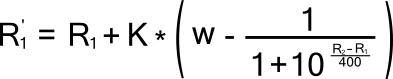

Figure 6 – Rating computation formula. W=1(won) or 0.5(tied) or 0(lost); R1 is the current rating of the player, R1’ is the new rating, R2 is the rating of the opponent, K is the maximum possible adjustment per game and this constant is set to 32 unless the player has a provisional rating, in that case K depends on the number of games played by the opponent.

Talking about ELO rating is not completely correct. It is more correct to talk about a rating used to have a rank in a top list.

Every provider uses its own formula, especially because ELO rating formula doesn’t work well when the players have played too few games. This is the problem of how to start computing the rating.

In order to start the rating computation you should have an initial rating. There are different ways:
  • get a fixed initial rating (1200, 1400 or 1500 for beginners) from the system; 
  • play a bunch of games without having assigned a rating so that after this period the system can determine the best estimation of your rating. Sometimes the system accept hints about your experience in chess in order to find the most appropriate opponents for you during the estimation; 
  • play with a provisional rating for 20 games and after that your rating is established. In this case the rating is computed using different formulas for established and provisional players. The initial rating is chosen by the player during the registration.
A derived problem is to take into account the fact that a player could have been away from tournaments for years before start playing again. This is a special case of the previous problem in fact in both cases the rating of the player is not sure. For this reason some providers use a different and more complicated formula called Glicko System [1].

Ladder is another possibility. No rating, only a rank in a ladder. People who win will raise the ladder, those who lose does not rise and soon will be taken over by others. The goal is to be at the top of the ladder (rank 1) instead of having the highest rating.

Famous chess programs have the concept of levels: beginner, intermediate, master. Splitting the number of games into rooms is useful to spread the load over more game servers. So why not create rooms based of player levels? Yes it is possible but less attractive than rating, isn’t it?

Ratings, ladders and levels are usually different for different categories of game: correspondence game, classical game, blitz game (3-5min), bullet (less than 3 min) and chess variants have their own rating.

Today I don’t feel concentrated enough but I would like to play a game anyway, just to spend time, but if a play and I lose I will compromise my rating. Some web sites give you the possibility to play a not rated game, so you can still play for training for example without compromise your rank or your rating.
Almost all providers ask you to sign up before starting use the service. It is reasonable because at least your nickname should be visible by your adversary. Someone could think: “why should I give my personal information like e-mail and nationality if I’m just trying to play a single game?” Very few web sites let you play chess as anonymous: no ratings, no registered games, no customizations, just play! In case they like the service they will sign up whenever they want.

[1] The Glicko System, Mark E. Glickman, http://math.bu.edu/people/mg/glicko/glicko.doc/glicko.html

Thursday, January 27, 2011

On-line Chess - Part 1.4 - Live or turn based

What do you think when you say chess? Yes, two people sat down by a chess board from their own side, thinking most of the time, handling their pieces from time to time and struck their clock button. Oh yes, I have seen also two people at the chess board, handling their pieces stressfully without any break, beating on their clock button with violence and thinking only in the spare time. Those scenarios are two typical examples of classic chess games (the second one is the so called blitz game).
Wait a moment. There is another kind of game, historically very important. It is correspondence chess. Two players exchange their moves by mail. There is no time constraint (or they are quite long).
Correspondence chess is easily implemented over internet. Each move is stored in a database and the player simply could be notified by e-mail that the opponent move has been issued. This kind of game is sometime called turn based game or postal game. A game of this kind must have an end, so there are long time limits to finish the game and to make a single move (I’m talking about days). Furthermore, what happens if you have a game in place from days but you have to go far from your (or any) PC for any reason but you don’t want to lose? Providers of such kind of chess game give you the possibility to go on “vacation” for a period: the game is simply suspended and everybody is happy. Vacation time is limited of course and during a game you cannot go on vacation more than a certain number of times.
The equivalent of classic chess is live chess or real time chess. In this case the chess clock plays a crucial role because the time variable can condition the game (and let people to make mistakes but that’s part of the beauty of the game). Often you can chose the time control with an extra time per move rather than the sudden-death approach: you will see two numbers when you chose the time limits, the first is the amount of time a player has in order to finish the game while the second is the bonus in seconds added to your clock every move you make. In the sudden-death time control when the time expires there is no time to play a single move.
Now, think at the following scenario: you are playing a live chess game, make your move and your clock stops while your opponent’s one starts (automatically done by the client program – what a great privation! I loved pushing the button on my classic chess clock.) but your opponent won’t see the move instantly because, due to the connection speed, the move information has to be uploaded to the server and forwarded to the opponent client. This time is called lag. Your opponent will see your chess clock going on for the time of the lag and when the move is received the clock goes back to the real time stamp.
Figure 3 – Lag example: client A sends its move to the server which forwards it to the client B. Client B receives the move and starts counting the time of B (Tb). When B moves it sends to server both the move and the time spent for the move Tb. Due to delay in B connection, the server receives the information after a time called LAG. In the meantime the clock B of the client A was ticking down and when A receives the opponent move and time, the clock B is updated and it appears player B has gained time, but it has not.

Any consequences? The total game time is longer that the one agreed at the beginning of the game. This is not a big issue because the lag time is a dead time for both players. Nasty instead is the situation very closed to the time zero: you make your move at 0:00:03 but your opponent receives it only after 5 sec. In the meantime your opponent sees your clock becoming negative and starts thinking happily about the victory but then receives your move and … checkmate! Gosh!
It is not advised to play rated games when a player has great lag and some web sites does not allow playing blitz games in case of consistent lag, in fact delays of seconds in the connection could make lightening games unfeasible.
Sometimes the players recognize the lag is increasing too much during a game and the provider gives them the possibility to abort the game or to adjourn to another day.

Some chess playing web sites have different approaches to lag phenomenon:
  • simply don’t do anything;
  • lag compensation: clocks are compensated with average lag. The perception of excessive lag effect is reduced and the lag is continuously measured;
  • automatic abort or adjourn of the game
  • not automatic abort or adjourn of the game but players agreed upon that adopt policies in case of lag
Very poor connections are affected by interruptions. Some good web sites takes care of poor internet connection of its users, when the disconnection arises the game is adjourned automatically or the user online gets notified to wait more, giving the time necessary for the disconnected user to reconnect and continue the game. That could lead to cheating problem and needs to be faced with (see security section).