Monday, May 8, 2017

MindTheCheck has changed!

MindTheCheck, the web site to play chess online, is changed, features and layout has been revised. New features have been added while others have been removed temporary and will be included later in the roadmap.
What is changed and why?
Time control: not all chess web sites allow you to customize the time control such as those with two or three periods used in official competitions and that’s a pity because even though 90% of online chess players play usual time limit, trying new time control could be interesting. The new release classifies chess games in four categories: bullet, blitz, regular e turn games. News are:
  • time compensation methods: time increment (Fischer delay) is used al lot in internet chess competition and was missed;
  • composing time control in more periods (up to 3) as in the most important chess competitions;
  • quantifying the lag during the online connection and using it to adapt the clock in order to have a fairer use of time between the players.
Turn based games  in the previous release were constrained to be 30 days per move, now they are allowed to be one day per move up to 30 days per move.

Rating: each game category has its own rating and it is always treated separately because of the different speed it requires. Players can monitor their statistics for each category.

Simultaneous games: it is understandable that more turn based games can be played simultaneously because of their slowness as the players have more time to focus on more battles; the new release allows users to play other game categories simultaneously that’s because it should be possible to play under stress condition for training or simply for fun.

Computer analysis: games can be analyzed by the strong chess engine Stockfish! You can submit to Stockfish analysis even positions loaded (FEN) or created or games loaded in PGN format.

Play computer: 8 levels are now available to challenge Stockfish chess engine. Now the availability of the engine opponent depends only on the browser version.

Sessions to share: played games can be shared using sessions among several users; you can share in real time games and positions. This feature is designed for those who want to do chess lessons remotely or for those who want to submit a game or a position to the attention and analysis of others.

The technology used for the new release is different in order to improve response time from the server. For this reason it is not available a mobile device version yet. Even the Big Game has been suspended for the moment waiting for the next new features in the roadmap.

So, MindTheCheck is a free chess service that is not still but moving continuously towards a new future.

Tuesday, April 1, 2014

The Big Game

The Big Game? What is it?
The Big Game (Il Partitone) is a two-team chess game. Each player chooses which side of the board he would like to play (white or black color), and so the team to join. It is not necessary to start partecipating from the very first move, however once the player has chosen his color, it will never change through the game.

How partecipate?
The user looks at the board position and, if he decides to join the team which has the turn, he just plays his move. The move gets registered as a suggestion but it won't be played yet.

What does it mean being a team member?
A player, before suggesting the move he believes to be the best, doesn't know which moves the other members have suggested so far. Those move will be unveiled just after the player's suggestion and, after that, it will be possible for the player to chat with the other members of the team.
So, each player suggests a move and he is unaware about what other members have suggested so far. After the player's suggestion, all other suggestions will be visible and the team members start communicating by chatting, discussing, analysing moves and strategies.
Obviously the two team are not supposed to communicating each other, neither seeing the suggestions of the opponent team.

How does the game step forward?
Every day, at 00:00 AM UTC, the most suggested move gets picked up and played. If two or more suggestions are eligible to be chosen, it will be picked  a move up at random among them.
If no proposal is available at 00:00 AM UTC, the decision is postponed of one day. The postponement can be grant for at most 6 times in a row.  

How does the game stop?
If no proposal is available after 7 days, the game will be time forfaited.
If most of the member resigns, the game will be terminated by resignation.
If the chosen move contains a draw proposal and the opponent team accepted it, the game will be draw.
If the chosen move leads to draw by stallmate, by material, by repetition or by the rule of 50 moves, the game will be draw.
If the chosen move is a checkmate, the game will be over.


MindTheCheck and its Big Games
Each MindTheCheck's  Big Game starts at 00:00 AM UTC after the termination of the previous Big Game, and all the Big Games are saved.
The access to the Big Game is free but requires a registration to MindTheCheck, which is free as well.

Monday, March 31, 2014

Play against the Computer...this is MindTheCheck!

MindTheCheck has a strong chess engine among its users and now you can play chess with it! The engine is the famous Sockfish, one of the strongest ever.

Why Stockfish? Here are the reasons:

  • it's open source;
  • it supports UCI protocol;
  • it has several skill levels.


UCI protocol makes the SW integration easy so a number of engines are based on this protocol (e.g. Shredder).
However, the free Shredder version (1.5) does not permit to change the skill level while Stockfish does, futhermore Stockfish has 20 different skill levels.

Is MindTheCheck equipped with a dedicated server for the chess engine?
No, it isn't. Instead there are several clients acting as an engine. The "Computer" is a MindTheCheck's user which connects to the website and stays available to play as long as it gets disconnected.
Clients balance the load: each engine instance will play one or more games at the same time. When a client disconnects, another client with less load at that moment will take over.

Playing is easy and quick, if you can't find any human opponent online, you will train yourself with the computer now.

Monday, November 25, 2013

First Round Robin Tournament

The upcoming  MtC event is scheduled to start on December 11th 2013! Its nickname is RRT (which stands for Round Robin Turn-based tournament) and it is the first double Round-Robin tournament, with rated turn-based games (we recall: the time for one move is 30 days). The tournament will start with no more then 8 partecipants and with at least 6! Pairings are made with Berger criteria and in case the number of registrations is odd, Anonymous will be the dummy partecipant. Tie break are handled using the Sonneborg-Berger, that is by adding scores of the opponents who were beaten by a given player and half the scores of the opponents who she drew with.

Wednesday, April 10, 2013

1^ Unrated SoM

MindTheCheck is pleased to announce the first Set Of Matches event!
Users will be able to register starting from May 21th and the event remains open for registration till June 10th.
The first SoM consists of up to 4  unrated turn-based chess games each player and it is a way to meet people on the virtual board and exploit the MindTheCheck features like the post-game analysis.
Unrated chess games do not alter the player ELO rating so people are free to play without worry too much about mistakes.
Turn-based games have very large time constraint (30 days timeout each move) so it gives players enough time to play a good game.

So, have nice games with MtC events!

Sunday, April 7, 2013

MindTheCheck's events


MindTheCheck is about to open a new section dedicated to events, such as tournaments and series of matches. Every registered user will be able to participate in these events, always FREE.
The section is still experimental, but would allow players to meet each other.

The first MtC event will be of type SoM (Set of Matches), ie a set of turn-based chess matches to a maximum of 4 matches per player. Each event will be accompanied by a special web space in order to monitor the progress of the event and ranking. The first SoM is friendly (unrated), ie the matches do not contribute to change the player's ELO rating: a way to socialize with the most active users of the Club.

When will be possible to apply to a new event, users will be notified by email. Among their settings it will be added an option to disable this service for those who does not want to receive this type of information.

Stay tuned, therefore, the first event of MindTheCheck is coming soon...


Sunday, January 27, 2013

Post-game analysis room

Mind The Check has recently released the new feature "post-game analysis", with which it is possible to comment on a game in real time with your opponent or anyone who wants to participate in the analysis.
It is a tool that aims to be a sort of chat at the board where, instead of words, the participants exchange moves, variations, lines of play, evaluations of positions and moves. Born to permit the player to review the game with the opponent which I consider an important moment in the noble Game, share those important moments that were crucial to the outcome of the game or are simply considered relevant.

How to access post-game analysis?
Only registered users can benefit of the post-match and only the players in a game, as owners of it, they can open a table of analysis on their game. Once opened, any registered user can intervene and eventually contribute.
You can access the ​​analysis area in three ways:
  1. immediately on conclusion of a game, clicking the "Analyze" button;
  2. from the list of matches, clicking on "Play" and then clicking on "Analyze" button;
  3. from the list of matches, if a table of analysis has already been created, by clicking on the "Analyze" button;
Let's see a concrete example of use of this tool.
Two players have just finished a game (for the sake of example the game follows a famous game between Richard Reti (2675) and Savielly Tartakower (2625), Vienna, 1910), black has abandoned and the button "Analyze" appears on top of the board.


Fig. 1 - The game is over and the button "Analyze" gets shown

When you click "Analyze" you go in another view, the analysis room, which contains a main board on the left, the list of moves int the center, navigation keys and controls to enter the comments that you want to match are just on bottom. On the right there is an empty space to contain diagrams of the lines other participant are analysing.

One can navigate between the moves in two ways:

  • with the navigation keys (in the center of which a pawn can flip the board)
  • by left-clicking with the mouse

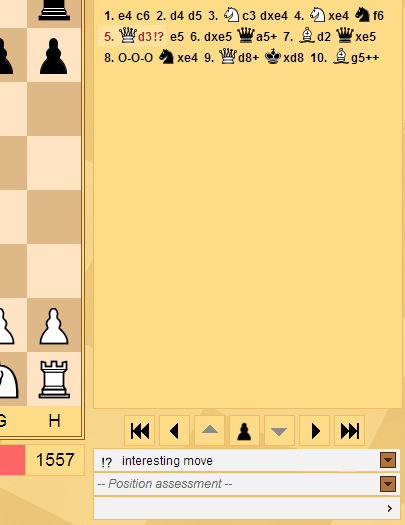
Assume you select Qd3 and add annotation to this move. The evaluation will be translated into symbolic form corresponding to the Numerical Annotation Glyph (NAG) and included in the list of moves.


Fig. 2 - An evaluation of Qd3

To add a text comment to the final move, you must enter the text in the editable text box and click the small arrow to the right.
To add a variant (in the example in place of 8 .... Cxe4), just move from a given position (8. 0-0-0) and the variant is created automatically.


How to interact with other participants?
Each time a participant wants to "see" or create a different line from what you are analyzing, in the right area you will see a diagram with their line of interest. If more participants are annotating the game at the same time, you'll see a set of diagrams on the right, one for each participant: if you want to follow the line of one of them just "click" on the diagram and "watch" on the main board about the evolution of this line and then break away when you want, by moving or positioning yourself on another existing position.


Fig. 3 - 10. Nf3 under analysis, but two other partecipants are evaluating different positions

There is no way to chat between participants because the goal here is the analysis: you discuss about the game in front of the board and the language is mainly the NAG.

This mode of interaction has no matches in the other online gaming sites even if I found some similarities but the purpose is very different. Mind The check seeks to share the analysis and manage the analysis at the same time creating a collaboration tool for chess players.

I hope I have done something pleasant to the players,
Good Game!


Monday, November 5, 2012

On-line Chess - Part 1.18 - Play for free

The most famous chess web sites hardly allow a player to play for free (unless you are a very famous chess player, in that case you are very welcome to join). Important chess servers’ access is not free but you can try for free for one week only. Others require a free registration with limited features and a premium registration with prices per month, 3 months, 6 months and per year. Premium memberships are full options in this case but there is a saving for long term registration.


Figure 14 – http://www.chesscube.com premium membership fees


Another policy is to have different premium memberships from the lowest level one with some features only to the highest level with full features.


Figure 15 – http://www.gameknot.com premium membership fees


Usually free registration limitations are on

  • the number of games playable at the same time or in a day, 
  • the possibility to access tournaments, 
  • the number of game archived is limited, 
  • computer analysis is not allowed, 
  • play in teams is not allowed, 
  • very basic statistics, colors and pieces customization are not allowed, just to mention a few.

Other providers who ask money as well to all the members offer an “exploration” mode in which the user can play for free for a limited amount of time or games. Expired this period they are invited to pay the fee for the next games.
Talking about money, some web sites allow playing with money (both symbolic and real). I understand that could be attractive for someone but I believe playing a game gives other immaterial earnings.


Saturday, November 3, 2012

On-line Chess - Part 1.17 - Other stuff

Playing chess on-line attracts several people, from the field and not. So it is not surprising that a web site providing the possibility to play has a store of chess material (boards, chess pieces, chess clocks, magazines, books, training material like videos, collection of games and so on). Another interesting feature to attract people mad of chess is chess puzzles. You are asked to solve the problem of the day typically. Sometimes the web site holds news from the chess world, tournaments, top players events, chess social events or international events with video, photos and articles. What about people who are not close to chess world? They want to find only an opponent to defeat or to chat with, the rest is useless…but is nice to have for the chess community.

On-line Chess - Part 1.16 - Population

It is very annoying to log-in, create a game and wait plenty of time because no one else in connected. Some popular web sites are full of people ready to play so that you don’t have to wait more that few second to find an opponent. Some other is completely unknown or less popular and the risk is to waste your time. There are some interesting web sites still unknown that are worth playing at, so I don’t want to give the advice to leave them empty. On the contrary I want to foster visiting those web sites, try and let them take off, especially if they are free!

Thursday, November 1, 2012

On-line Chess - Part 1.15 - Graphics

Beauty is a subjective parameter during the evaluation of a web site. What does it mean? When you play chess at home or in a chess club it doesn’t matter if the board is made of cardboard and the pieces are made of plastic. What’s really matter is the game, the battle and who will win. Is it really true? If you have the chance to chose between a cardboard chess board and a wooden board with sheesham chessmen, which one will you chose? Now, back to the on-line chess. There are a lot of chess pieces pictures on the web and the game providers let their user to choose between different styles, colors and dimension of both sets and board squares. Sometimes the number of possibilities is limited if the subscription is free while if you pay for a premium subscription the choice is greater.


Figure 13 - Graphic interface Come2Play from www.come2play.com

Chessboard and sets are not the only graphic parameter to judge. Font is another parameter. Sometimes the font is too small or the text components in the web page are too close, or on the page there are fonts of different kind. If the web page contains too much information with small font together with bigger and different font, it could be difficult to find the information you need.

Anyway the beauty is subjective. Someone prefers simplicity: few things but very good.

Wednesday, October 31, 2012

On-line Chess - Part 1.14 - Play everywher

Nowadays computers are not the only mean to reach internet. Cell phones, smart phones, iPhone, iPod, Wii and so on have access to internet. Big online chess providers know about this revolution and adapted their web sites to be reached from those devices. The cost is high for the provider and so it is difficult to find this feature for free. Typically there is an application to download on your portable device which is the client program. Even if the download is free, if you want to play often or affect your rating you should pay a fee.


Figure 12 – iPhone application provided by http://www.chess.com

Furthermore social networks counts thousands of people and give the possibility for developers to public their software to be used by social networks’ users. So if you want to play chess online you surely will find a way!

Tuesday, October 30, 2012

On-line Chess - Part 1.13 - Security

On a real chess game it is not possible to cheat. Online chess games instead can be cheated in several ways depending of the security model implemented. Yah, the server receives the information about the move and the timestamp from the clients. Nobody is able to see what the user is doing sitting in front of his/her PC. Let’s start from the most common cheating type: the computer aid. Instead of using their own brain, cheaters open a window on their PC where their favorite chess program is running. The position of the game in progress is replicated in the chess program and analyzed by the CPU (which will do the dirty job), the program hints the best move for every position and unlucky opponents can be defeated soon if not stronger than the machine. The consequence is that cheaters gain points rapidly and they will be at the top of the ladder even if not deserved. Is there a remedy for that? Some online game providers claim they have one. The principle is that suspicious games are analyzed with a computer engine and if there is a match that is the footprint of a cheat. Can anyone be sure 100% that it is a cheat? Difficult to say. Anyway other techniques can be added and the following three are just examples:
  • The rating evolution is monitored because a quick rising of the rating is a symptom of good game but also of cheating. 
  • The suspect cheater is notified by a message encouraging him/her to stop cheating or simply informing that from now on a strict monitoring will be performed on his/her games. 
  • The suspect cheater is marked so that every user knows what could happen if they accept a challenge from a suspect cheater. 
  • The number of times the game is suspended is monitored. It could be an indication that the player is using the time to query a chess program.
When the cheater is confirmed he/she is banned from using the chess service.
Another popular way to gain points is to play against yourself. Cheaters create two accounts and winning against themselves let them improve their rating. Some game providers overcome this techniques by force the users at registration time to accept to not create more than one account otherwise they will be banned. Some other game providers instead have tools to detect if the players of a game come from the same IP address. What if the cheater uses two different PC?
  Another historical way to cheat an opponent is to interrupt the game when thing is going bad on the board. Let’s think the case there is a temporary connection failure of a client. Some game providers simply null the game because they think it is unfair to assign a result in this case. But cheaters could turn off their computer in order to simulate an internet connection failure. Usually providers face this problem in two ways:
  • adjourning the game when accidental disconnection has happened and give the chance to reconnect in order to complete the game 
  • declaring the victory for the player remained online
Other providers claim they have an intelligent system able to recognize abusive game interruptions, which is the best solution to the problem.
Now let’s have a look at complex cheating techniques. As we already said, the client program sends a time stamp together with the move up to the server. Time stamp could be modified to get more time. Usually the connection between the client and the server is encrypted but even the most famous chess server (ICC) has not a strong protection against hackers that could decrypt the message and change the time stamp.

Monday, October 29, 2012

On-line Chess - Part 1.12 - Customizations

As a user of the game service you have the chance to customize the interface you use to play. Type of chess pieces and colors of white and dark squares of the board are examples of personal settings.
 Figure 11www.chess.com board settings

Another common one is the automatic pawn promotion to queen. Even if sometimes there are not so many choices this features in nice to have. The move highlight is useful when you want to see quickly what the opponent move is when you come back to your monitor. Other minor settings are the movement of the piece when you move or the alert sounds.

Sunday, October 28, 2012

On-line Chess - Part 1.11 - Analysis

Your games are stored in a database so they are available to all people to inspect and comment. Analyzing games is useful for improvements and on-line gaming providers allow their users to have this feature. How? In several ways. First of all the user can post the game to a forum and wait for someone to review and comment. Simple and effective, because when a lot of people could analyze your game and so the amount of data produced could be very interesting, with no cost for the provider. The drawback is that it could happen no one wants to review your game or the reviewers are not good enough. Sometimes there is a committee entitled for reviewing the games when required. In this case the guys in the committee should be prepared enough for producing good quality comments. Another scenario is the help of a computer program. Your game is put in queue and it will wait to be processed by a chess engine. This solution has a cost in terms of hardware resources to guarantee the service to every user, while the chess engine could be open Source. Other commercial chess engines, like Fritz for instance, perform better analysis so someone prefers to download the PGN format of the game and run his/her favorite chess engine for a deep analysis.

Analysis is good for training but is lesser amusing than reviewing the game with your opponent at the end of a match, still in front of the chessboard with the clock still warm. Ok, the quality of the analysis is poor but you still have your variants in your mind and would like to see the reaction of the opponent.

Saturday, October 27, 2012

On-line Chess - Part 1.10 - Game archive and statistics

A good player takes note of the move list of his/her games in order to analyze later and improve from mistakes. No piece of paper is required when you play on-line chess because the system takes note of the game moves and save the game in the Portable Game Notation format in a database. That’s really useful. Database access makes it easy to query for a match against an opponent or for a game played years ago. You can then review the game using your client program or download the PGN file and open it using your favorite computer chess program in order to let it analyze deeply the game and find the mistakes and good moves. Game archive has a cost for providers of the gaming service (disk space is not for free), for this reason usually if you want to store all your games you have to pay while free subscription have limited storage size.
Figure 10 – www.geekswithchess.com game archive

Another possibility is to upload games in PGN format on the database. Even if they are not played using the provider service, this is a way to collect the games you want on the net so they become available everywhere an internet connection is available.
Statistics are another interesting feature. In the basic form statistics report the number of games played, won, drawn and lost. Advanced forms could report your rating evolution over time or the statistics on openings used in your games and several ways to present the data graphically. Any means to show you how strong you are is appreciated.

On-line Chess - Part 1.9 - Games watching

If you ever entered a chess club, for sure you have stop by a table watching a game in progress. Observing a game in progress just like a real spectator is possible also on-line. Typically there is a list of ongoing games and you can join to watch one of them. Some time you are allowed to write down messages into the local chat.
Figure 9www.chess.com game view panel

Saturday, October 13, 2012

Welcome Mind The Check!


Mind The Check is the new web site for playing online chess for free. it offers the chance to play correspondence chess (turn based chess) and live chess(time based chess), rated and unrated games, gives the players the opportunity to check their progress in term of strength and look at their own games whenever they want.

The site is online for some time but it unveils itself only recently to the web community, thanks to its latest stable version that makes use of cutting-edge software technologies as JSF2.0 and Atmosphere Framework.

The project was created by combining the need to renew competence and the curiosity for some emerging technologies, finding in an old interest in the Game of Chess, a breeding ground for this activity. By the time the project has grown, maintaining the same spirit and gaining expertise everytime an obstacle got passed,  opening the door to new ideas and new challenges.

Mind The Check is constantly evolving, so many ideas still have to be realized, but it is now ready to be known and it is open to any advice or suggestions that can make the chess player life on the virtual chess board easier or just more interesting.

Good game!

Sunday, September 30, 2012

On-line Chess - Part 1.8 - Other play possibilities

Usually you are not allowed to play more than one game at a time mainly for security as we will see later. That’s not true for all the gaming sites.
But let’s go back to the rating concept. You can play against anyone and increase your rating, very easy. Too easy maybe: in the real world to increase your rating you should participate to official tournaments. For this reason it is very common to find tournaments on-line. Tournaments start when a certain number of people join the tournament which is scheduled at a fixed time and publicized on the site.
Tournaments could be of various types:
  • In round-robin tournaments each player plays against every other player in two games (once as white, once as black). The winner is determined by the score but when two players have the same score a tie-break method can be used. The tie-break method widely used for this kind of tournament is the Neustadtl score. A player's Neustadtl score is calculated by adding the sum of the conventional scores of the players they have defeated to half the sum of the conventional scores of those they have drawn against. Round-robin tournaments are simple but they are effective only when the number of players is limited to few users.
  • Knock-out tournaments are used when there are a lot of players in order to reduce the time taken by the competition. Players are put into smaller groups and then the winner(s) of that group are combined with winners of other groups to form a new group. The winner(s) of the final group are the winner(s) of the entire tournament. One or more players could advance from each group. If one only has to advance, a tie-break method is used.
  • A Swiss tournament goes for a predetermined number of rounds, with all of the players taking part in each round. In each round two players compete head-to-head. All players participate in the entire tournament – none are eliminated. The winner (and top places) of the tournament is based on the final scores of the players. The final score is based on the number of points they accumulated for each round. The tournament lasts for a number of rounds announced before the tournament. After the last round, players are ranked by their score. If this is tied then a tie break score, such as the sum of all their opponents' scores (Buchholz chess rating), can be used. The Buchholz System is in fact the sum of the score of each of the opponents of a player. 
 
When the users of a web site are quite a number, it is common to find teams of players playing against. Not a one-to-one challenge but a many-to-many challenge. The team wins if the score of its members is higher than other teams after the fight. Team members become friends, they exchange information trough dedicated chat.
Also teams can compete in tournaments. In this case the rating is different.
Some game providers allow users to play different chess variants and gain rating also for those games. The most popular chess variants you can find are
  • Chess 960
  • Reverse (suicide chess)
  • Checkers
  • Bughouse

Friday, February 25, 2011

On-line Chess - Part 1.7 - Challenges


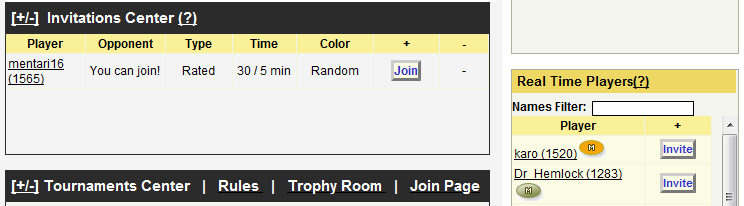
Ok, you logged in to a chess on-line web site and you are ready to start a game but how could you find an opponent? There are several ways to. The most common is the direct challenge: from the list of on-line users you chose the one you would like to play with. Yes, maybe you know the player by its nickname and would like to play with him/her, or looking at the player rating you can chose to challenge someone a bit stronger than you to increase your own rating. So the choice is yours in this case.


Figure 7http://www.chesshere.com allows the player to invite another player and to show the list of current invitations

There is another possibility: you create the game you want (setting time limits and color for instance) and wait for someone to come to your table. In the other way round, you see a list of created games with their characteristics and you can chose to join the game you want. Nice, but you may ask: “why should I see a list of lots of games I don’t want to play?” In fact, you may be not interested to play against too much stronger people, or too much weaker people. That’s why some good gaming web sites allow their user to set constraints when creating the game. Those constraints limit the possible opponents to players with a rating inside a fixed range or inside a range around the creator rating (300 points below and 300 points above for instance).


Figure 8http://www.chesscube.com game creation with rating range constraint

A similar concept is used by other sites where each player specifies the constraints and the system will find automatically an opponent that fulfills that requirements: the user does not chose to join the game because it is not allowed to see the list of created games.

What happens if there is none who can play with you? Play against a computer seems to be a forced choice but is it what you really wanted? It is better to be clear: “Sorry, no one available. Retry or if you want you can play against the machine”.

Interesting is the feature to invite a friend of yours even if he/she is not a registered user. The invitation needs only the email address and if your friend is checking his/her email in that moment he/she could join the game with you (but if he is not connected…).

I talked about friends. That is a concept widely used in most gaming web sites. You have the chance to maintain a list of other users (your friends) and check if they are connected, if so you can challenge one of them or chat with him/her. The concept behind is simple: a friend is someone you want to be connected with, someone you want to play with often. Some online chess providers have another interesting feature which is the opposite of friends: a list of people you don’t want to play with. In fact when the system finds automatically an opponent for you, you won’t have the chance to reject the match usually (in some case instead that is possible: the game can be null if the player doesn’t move his first move or acknowledges the match). Using the black list (or block list or no-play list) the system will not create a match between you and the undesired user.