Sunday, September 30, 2012

On-line Chess - Part 1.8 - Other play possibilities

Usually you are not allowed to play more than one game at a time mainly for security as we will see later. That’s not true for all the gaming sites.
But let’s go back to the rating concept. You can play against anyone and increase your rating, very easy. Too easy maybe: in the real world to increase your rating you should participate to official tournaments. For this reason it is very common to find tournaments on-line. Tournaments start when a certain number of people join the tournament which is scheduled at a fixed time and publicized on the site.
Tournaments could be of various types:
  • In round-robin tournaments each player plays against every other player in two games (once as white, once as black). The winner is determined by the score but when two players have the same score a tie-break method can be used. The tie-break method widely used for this kind of tournament is the Neustadtl score. A player's Neustadtl score is calculated by adding the sum of the conventional scores of the players they have defeated to half the sum of the conventional scores of those they have drawn against. Round-robin tournaments are simple but they are effective only when the number of players is limited to few users.
  • Knock-out tournaments are used when there are a lot of players in order to reduce the time taken by the competition. Players are put into smaller groups and then the winner(s) of that group are combined with winners of other groups to form a new group. The winner(s) of the final group are the winner(s) of the entire tournament. One or more players could advance from each group. If one only has to advance, a tie-break method is used.
  • A Swiss tournament goes for a predetermined number of rounds, with all of the players taking part in each round. In each round two players compete head-to-head. All players participate in the entire tournament – none are eliminated. The winner (and top places) of the tournament is based on the final scores of the players. The final score is based on the number of points they accumulated for each round. The tournament lasts for a number of rounds announced before the tournament. After the last round, players are ranked by their score. If this is tied then a tie break score, such as the sum of all their opponents' scores (Buchholz chess rating), can be used. The Buchholz System is in fact the sum of the score of each of the opponents of a player. 
 
When the users of a web site are quite a number, it is common to find teams of players playing against. Not a one-to-one challenge but a many-to-many challenge. The team wins if the score of its members is higher than other teams after the fight. Team members become friends, they exchange information trough dedicated chat.
Also teams can compete in tournaments. In this case the rating is different.
Some game providers allow users to play different chess variants and gain rating also for those games. The most popular chess variants you can find are
  • Chess 960
  • Reverse (suicide chess)
  • Checkers
  • Bughouse

Friday, February 25, 2011

On-line Chess - Part 1.7 - Challenges


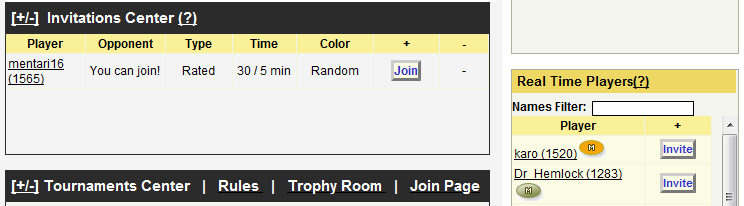
Ok, you logged in to a chess on-line web site and you are ready to start a game but how could you find an opponent? There are several ways to. The most common is the direct challenge: from the list of on-line users you chose the one you would like to play with. Yes, maybe you know the player by its nickname and would like to play with him/her, or looking at the player rating you can chose to challenge someone a bit stronger than you to increase your own rating. So the choice is yours in this case.


Figure 7http://www.chesshere.com allows the player to invite another player and to show the list of current invitations

There is another possibility: you create the game you want (setting time limits and color for instance) and wait for someone to come to your table. In the other way round, you see a list of created games with their characteristics and you can chose to join the game you want. Nice, but you may ask: “why should I see a list of lots of games I don’t want to play?” In fact, you may be not interested to play against too much stronger people, or too much weaker people. That’s why some good gaming web sites allow their user to set constraints when creating the game. Those constraints limit the possible opponents to players with a rating inside a fixed range or inside a range around the creator rating (300 points below and 300 points above for instance).


Figure 8http://www.chesscube.com game creation with rating range constraint

A similar concept is used by other sites where each player specifies the constraints and the system will find automatically an opponent that fulfills that requirements: the user does not chose to join the game because it is not allowed to see the list of created games.

What happens if there is none who can play with you? Play against a computer seems to be a forced choice but is it what you really wanted? It is better to be clear: “Sorry, no one available. Retry or if you want you can play against the machine”.

Interesting is the feature to invite a friend of yours even if he/she is not a registered user. The invitation needs only the email address and if your friend is checking his/her email in that moment he/she could join the game with you (but if he is not connected…).

I talked about friends. That is a concept widely used in most gaming web sites. You have the chance to maintain a list of other users (your friends) and check if they are connected, if so you can challenge one of them or chat with him/her. The concept behind is simple: a friend is someone you want to be connected with, someone you want to play with often. Some online chess providers have another interesting feature which is the opposite of friends: a list of people you don’t want to play with. In fact when the system finds automatically an opponent for you, you won’t have the chance to reject the match usually (in some case instead that is possible: the game can be null if the player doesn’t move his first move or acknowledges the match). Using the black list (or block list or no-play list) the system will not create a match between you and the undesired user.

Thursday, February 3, 2011

On-line Chess - Part 1.6 - Rating and levels


Why playing a game like chess is addictive? Because it is a beautiful game! Yes, of course. Because you meet people! Yes. Because you like the theory behind! Yah. But unconsciously a better answer is because you want to prove you’re stronger than the opponent. Another variant: because you want to prove you’re stronger than a lot of people. A more modest variant: because you want to prove you’re the strongest player, that’s all!

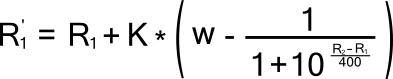
Rating helps to find your strength among other player. ELO rating is the most used. It is a simple formula returning a number: bigger the number, stronger you are.


Figure 6 – Rating computation formula. W=1(won) or 0.5(tied) or 0(lost); R1 is the current rating of the player, R1’ is the new rating, R2 is the rating of the opponent, K is the maximum possible adjustment per game and this constant is set to 32 unless the player has a provisional rating, in that case K depends on the number of games played by the opponent.

Talking about ELO rating is not completely correct. It is more correct to talk about a rating used to have a rank in a top list.

Every provider uses its own formula, especially because ELO rating formula doesn’t work well when the players have played too few games. This is the problem of how to start computing the rating.

In order to start the rating computation you should have an initial rating. There are different ways:
  • get a fixed initial rating (1200, 1400 or 1500 for beginners) from the system; 
  • play a bunch of games without having assigned a rating so that after this period the system can determine the best estimation of your rating. Sometimes the system accept hints about your experience in chess in order to find the most appropriate opponents for you during the estimation; 
  • play with a provisional rating for 20 games and after that your rating is established. In this case the rating is computed using different formulas for established and provisional players. The initial rating is chosen by the player during the registration.
A derived problem is to take into account the fact that a player could have been away from tournaments for years before start playing again. This is a special case of the previous problem in fact in both cases the rating of the player is not sure. For this reason some providers use a different and more complicated formula called Glicko System [1].

Ladder is another possibility. No rating, only a rank in a ladder. People who win will raise the ladder, those who lose does not rise and soon will be taken over by others. The goal is to be at the top of the ladder (rank 1) instead of having the highest rating.

Famous chess programs have the concept of levels: beginner, intermediate, master. Splitting the number of games into rooms is useful to spread the load over more game servers. So why not create rooms based of player levels? Yes it is possible but less attractive than rating, isn’t it?

Ratings, ladders and levels are usually different for different categories of game: correspondence game, classical game, blitz game (3-5min), bullet (less than 3 min) and chess variants have their own rating.

Today I don’t feel concentrated enough but I would like to play a game anyway, just to spend time, but if a play and I lose I will compromise my rating. Some web sites give you the possibility to play a not rated game, so you can still play for training for example without compromise your rank or your rating.
Almost all providers ask you to sign up before starting use the service. It is reasonable because at least your nickname should be visible by your adversary. Someone could think: “why should I give my personal information like e-mail and nationality if I’m just trying to play a single game?” Very few web sites let you play chess as anonymous: no ratings, no registered games, no customizations, just play! In case they like the service they will sign up whenever they want.

[1] The Glicko System, Mark E. Glickman, http://math.bu.edu/people/mg/glicko/glicko.doc/glicko.html

Friday, January 28, 2011

On-line Chess - Part 1.5 - Social meetings


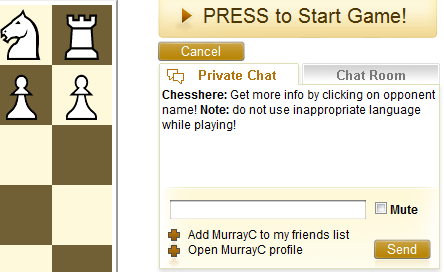
Usually when you play chess you don’t speak with your opponent…or you don’t speak at all. But on-line it is different, people like chatting, like knows something more about the opponent person rather then its name and nationality (and optionally an avatar). A chat feature is always provided by every on-line gaming web site. You can find different kinds of chat:

  • during the game: it is a private chat only between the two players; 
  • public or general chat: every user can post a message and usually is for wave a challenge; 
  • in rooms or thematic chat rooms: nothing to do with playing chess, it is just chatting; 
  • among team members: a team is a group of player that competes against other teams; 
  • in clubs: a club is the place where you can meet new friends, discuss things and play games. It can be found by anybody and club founder and club moderators are responsible for everything that happens in the club.
Chats are usually controlled in order to filter offensive words. The abuse of the chat service is mentioned into the terms and conditions of the service and it is punished by banning the bad user. In some cases the chat is forbidden for users under 13.


Figure 4www.instantchess.com private chat


Figure 5www.chesshere.com private chat and chat room

Almost all web sites allow their users to have a list of their friends in order to connect with them easily by chat or for playing. When you meet a new player in a game and find out he/she is a good player or simply it is nice to chat with, having him/her in your list help you looking for him/her when you connect next time.

So, on-line chess gaming web sites are, as a matter of facts, a sort of social networks and in most case is possible to find connections with popular social networks websites like facebook.